
From the President's Desk:
Snippets from the Board
New Retirement Villages Education Centre Video
Education Centre Year in Retrospect
2025 RVRA Budget & Asset Management Plan Survey – Final Report
The Challenges of Adding an Additional Name to a NSW Retirement Village Lease
Our Care System is Cracking – Band-Aids Won’t Fix It
President’s Message: Wellbeing Must be at the Heart of Village Life
New Section for 2026: Letters to the Editor
FYI - Important Information Links
Help Support YOUR Association - for the future
RVRA Supporters

Hi everyone
Another busy month in the retirement village sector in NSW and across Australia. Even though we are NSW based what happens in other states can have an impact on us particularly if your village operator has villages in multi states.
Some November sector happenings are as follows:
1. NSW Legislative and Compliance Activity – Late 2025 Update
Although the major regulatory overhaul commenced with the Retirement Villages Regulation 2025 (NSW) in September, several follow-on compliance requirements and implementation expectations have emerged during November.
Key points for residents, committees and associations:
- Annual safety & emergency-readiness documentation: NSW Fair Trading has advised operators that 2025–26 will involve targeted audits on fire safety systems, evacuation procedures, and incident reporting — with retirement villages included as a priority risk category.
- Mandatory publication of annual financial statements: Operators must now make annual financial statements available to all residents in both hardcopy and digital formats (where offered), ensuring transparency around surpluses/deficits, major cost drivers, and insurance premium changes.
- Refinement of elder-abuse prevention obligations: Operators have been encouraged to demonstrate active education programs for staff and volunteers — not just a written strategy. This includes annual refresher training and clear complaint-pathway information for residents.
- Financial governance expectations: Committees have been reminded that they may formally request sighting of supporting evidence behind capital-maintenance claims — not simply the annual summary.
Implications for residents & committees:
- Committees may wish to check whether the operator has updated the 2025–26 safety documentation and ensured that emergency procedures reflect the village’s current layout.
- Residents should ensure they have received the annual financial statement and seek clarification on any unusual cost movements — especially insurance, utilities and contracted services.
- The strengthened elder-abuse compliance environment gives committees stronger footing in requesting transparent behavioural policies and clear issue-escalation pathways.
- These November developments reinforce that operators are expected to:
- maintain transparent accounts,
- provide thorough, accessible safety information, and
- show measurable compliance actions, not just policies on paper.
Continued below...
2. Cost Pressures & Insurance Market Update
Insurance challenges remain a dominant issue across the sector.
Current developments:
- Some operators have reported further premium increases of 8–15% for the 2025–26 renewal cycle — particularly in coastal or bushfire-prone areas.
- A number of insurers have tightened requirements for roof condition, electrical safety certification, and proactive maintenance before offering renewal terms.
- Operators are increasingly exploring group insurance arrangements, although availability varies.
Implications for residents & committees:
- Rising premiums may flow into 2026 budgets, affecting recurrent charges. Committees may wish to request early budget drafts or explanatory notes.
- The heightened focus on asset condition strengthens the importance of reviewing remaining effective-life entries in the asset register.
- Villages that cannot demonstrate adequate preventative maintenance risk higher premiums or more exclusions — making transparent planning documents critical.
3. Resident Wellbeing, Social Connection & Digital Access
Heading into the festive season, November has seen increased activity in community wellbeing initiatives.
Sector themes this month:
- More villages have introduced mental-health awareness sessions, reflecting continued emphasis on social isolation risks among older residents.
- A rise in resident-led social committees, focusing on inclusive, culturally diverse end-of-year events.
- Increased adoption of digital noticeboards and online maintenance reporting — but with strong feedback from residents wanting parallel non-digital options.
Implications:
- Resident committees play an important role in shaping inclusive and accessible social programmes.
- Operators are being reminded to maintain service accessibility for residents who prefer or require non-digital communication options.
Board Matters
Your board and staff held its annual face-to-face meeting in Sydney in early November. This is the only time we gather in person; all other meetings are conducted via Zoom. We welcomed new board members Colin Long, Denise McGowen-Slee and Bernadette Jasper.
During the face-to-face meeting we planned the year ahead and allocated tasks to board members. Stay tuned for some exciting and innovative projects next year.
We have two vacancies on the board and would welcome expressions of interest from those with IT skills and website development or maintenance experience. If you are interested, please contact our Secretary Fran at: secretary@rvra.org.au.
This month’s Bulletin includes vital information on adding additional names to your lease, and news on the care system from the Retirement Living Council. We hope you find the articles informative.
Roger Pallant
RVRA President

It’s hard to believe the year has almost ended! Now is the time to wind down and enjoy the festivities both in your village and with friends and families.
The Board has been busy during October and November. We have continued to meet with representatives from the Property Council, the Retirement Living Council, Fair Trading, and Operators, and have been out and about at various engagements including the recent DCMI Summit in Brisbane, reported on in this months Bulletin.
Members Enquiries
There were 27 enquiries from members covering a total of 41 categories (some enquiries covered 2 or more call categories) during October. The largest number of calls categories were about Management (10), followed by Finance and Budgets (8), and Residents Committees (7).
Members can access Information Sheets dealing with these and many topics in the Members Only section of the website. The Information Sheets links are being updated to the new 2025 Regulation but are quite usable in the interim.
The Retirement Villages Education Centre
The second video in the “Finances in Retirement Villages” series, “Understanding ongoing costs while living in a Retirement Village” is ready for viewing and is posted on the website and the RVRA You Tube channel. It will be closely followed by video 3: “Understanding the costs of leaving a Retirement Village”.
Village Visits
We offer virtual village visits for those regional NSW villages where we cannot face-to-face visit to acquaint residents with the supporting role of the RVRA. If you wish your village to be included in the Village Visit schedule, virtual or face-to-face, please contact Cathy on 1300 787 213 (option 1) if you have not already done so.
Annual RVRA Budget and AMP Survey
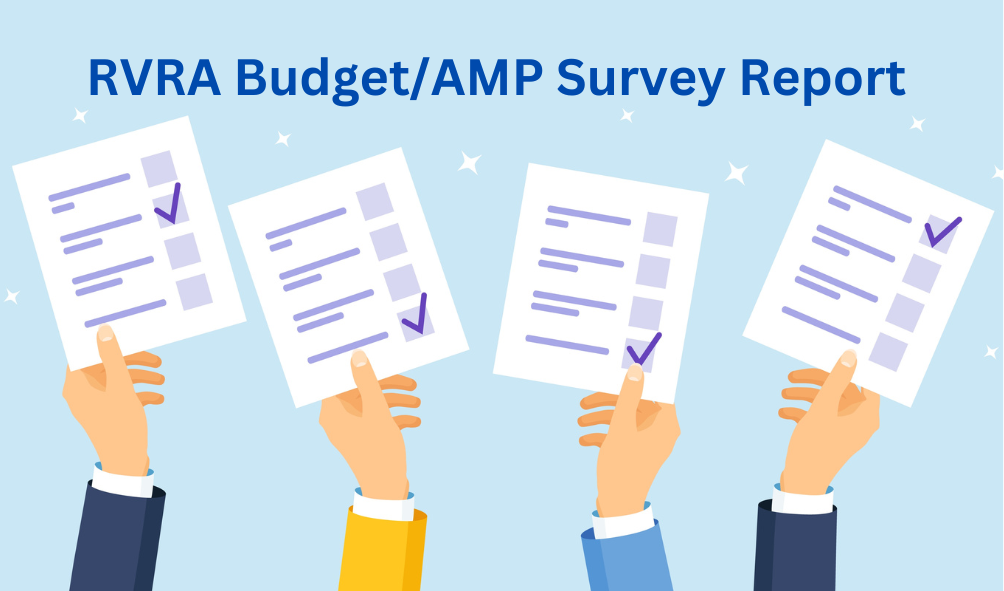
The RVRA 2025 Budget and Asset Management Plan Survey Report is now available for review HERE
The Survey covered 553 respondents from 161 different villages from all over NSW and many commented on their village’s experiences with the 2025/26 Budget and Asset Management Plan, giving us much valued insights into the concerns of Retirement Village residents.
We thank our members for their participation on this annual survey. Data from the Survey will provide guidance for future RVRA discussions and submissions with various NSW bodies in relation to Retirement Village legislation.

We have now released our second video in our series about the costs of moving into a retirement village.
This three-part finance series breaks the topic into bite-sized, practical videos so residents and committees can understand what to expect, compare options, and plan with confidence.
Video 2: The costs of living in a Retirement Village
- https://www.rvra.org.au/education/videos
2025 was a year of consolidation and practical growth for the NSW RVRA Education Centre. It expanded resident‑led video content, published its Education Centre Report for 2025, and strengthened partnerships that increased reach across NSW retirement villages.
The Education Centre continued its mission to provide clear, resident‑led guidance on retirement village law and living, building on the Centre’s foundation of research and resource development and supported by the NSW Government. The RVRA’s broader organisational role as a volunteer association representing NSW village residents remained central to how the Centre prioritised topics and delivery systems.
Challenges in 2025 included translating complex legal and policy changes into accessible formats and ensuring access to digital content for less tech‑confident residents. The RVRA used its existing channels—monthly bulletins, the website, and social media—to promote Education Centre content, increasing visibility among members and prospective residents. The Centre’s resident‑authored approach and accessible formats helped maintain trust and relevance, particularly for older audiences who value clear, locally grounded advice.
Key achievements:
- The expanded video series focused on the costs of entering, living in, and exiting NSW retirement villages; these resident‑led videos were developed with NSW Fair Trading funding and rolled out during 2025.
- Residents committee workshops continued both via Zoom and face-to-face; embracing a variety of formats designed to expand their reach into regional NSW.
- Notable Bulletin articles included
- Advocacy spotlight features that framed the RVRA’s priorities through 2025, summarising regulatory developments and the association’s strategic focus for members including coverage of RVRA submissions and media commentary on Asset Management Plan costs.
- Aged Care Reform and Support at Home articles to help residents understand recent fee changes and how they might affect village residents.
- Reports on national and state forums on sector trends and policy implications.
- Health and wellbeing items timed to national awareness days, providing localised advice and signposts to resources for residents.
- The Education Centre AGM Report that summarised 2024/25 activity and priorities, giving the Centre a clearer public mandate and a baseline for measuring impact.
The Outreach program continued, including structured “village visit” formats by Zoom and in‑person where possible that brought Education Centre content directly into communities and supported local residents committees.
- The integration of survey and research results into outreach planning, using the national survey “Have Your Say” findings and the RVRA Annual Budget and AMP Survey to prioritise topics and tailor outreach to NSW‑specific concerns.
- Stronger collaboration with sector partners supported resource production and distribution, helping the Centre scale without losing its resident‑led focus. The RVRA’s public advocacy and participation in sector forums during 2025 reinforced the Education Centre’s role as both an educator and a voice for residents’ priorities in broader policy discussions.
- The commitment to a strong government partnership with the NSW Government enabled the Centre to reinforce its credibility and reach.
The Centre’s 2025 work established a clear content base designed by residents for residents and supported through partnerships with NSW agencies and sector stakeholders. The Education Centre enters 2026 positioned to convert 2025’s momentum into measurable impact. We expect continued growth in resident‑authored short videos and resource sheets, a strong webinar and village‑visit outreach mix, and a continuing emphasis on evaluation and regional access to close the digital divide. Diane Hart Chair, RVRA Education Centre
Final Report - Out Now
Each year we ask our members to share their experiences with village budgets, recurrent charges and Asset Management Plans. This 2025 survey drew more than 550 responses from residents across 161 NSW villages, providing a clear picture of current practices, emerging concerns and the issues most affecting village life.
The report outlines key findings, trends over the past four years, and the views residents expressed about transparency, affordability, management engagement and the role of residents committees. It offers an evidence-based snapshot of how budgets and AMPs are working in practice and where improvements are needed.
We appreciate the time taken by all participants and are pleased to present the full results below.

Adding an additional name to a retirement village lease in New South Wales can appear straightforward, but in practice it often raises a number of legal, administrative, and practical issues. These challenges highlight the importance of understanding the structure of retirement village contracts and ensuring all intended residents are correctly named on the lease before the agreement is executed.
One common question is whether a retirement village operator is presumed to consent to adding an additional resident’s name when no obvious impediment exists. Generally, there is no legal presumption that an operator must approve such a request. Retirement village leases—often structured as long-term licences, leases, or loan-licence arrangements—are governed by carefully drafted contracts that form part of a regulated statutory scheme under the Retirement Villages Act 1999 (NSW). Because of this, operators maintain strict control over who is named as a resident and party to the contract. Even if a second prospective resident meets all age, health, and suitability criteria, operators often retain absolute discretion to approve or deny the addition of a name. Their decision may take into account financial capacity, compliance with village policies, and the administrative burden of amending documents that have already commenced. Importantly, the operator’s consent must be obtained, and they are under no automatic obligation to grant it simply because no impediment is apparent to the incoming resident.
An important point to note is the need to ensure that at the time of signing, the lease unequivocally provides for the future addition to the lease, whilst the resident occupies the premises, of any person with whom the resident claims to have set up a “live-in” relationship.
Cost is another significant consideration. Where an operator allows the addition of a name, the work is normally carried out by the operator’s own solicitor. Residents should expect to pay reasonable legal and administrative costs, which typically include the solicitor’s time for amending the lease or residence contract, updating disclosure statements, and arranging execution of revised documents. In many cases this may also involve re-registration of documents, depending on the village’s contractual model. While costs vary from operator to operator, it is not uncommon for legal fees to fall within a few hundred to several thousand dollars, depending on complexity. Because the resident does not usually have the option to choose the solicitor, they also have limited control over fee structures or hourly rates.
These challenges reinforce a crucial lesson: prospective residents must take great care before signing any retirement village contract to ensure that all intended occupants are named on the lease from the outset. Including both partners—whether married, de facto, or otherwise—on the original contract offers significant protection. Most importantly, it ensures continuity of residence upon the death of one resident. If only one individual is named on the lease and that person dies, the surviving partner is not automatically entitled to remain in the unit. Their right to stay may depend entirely on the operator’s discretion, creating uncertainty and potential distress at a vulnerable time.
In summary, adding a name to an existing NSW retirement village lease can be procedurally complex, costly, and not guaranteed. Prospective residents should therefore ensure that all relevant names are included in the initial contract, safeguarding security of tenure and peace of mind for the future.
Len Mahemoff OAM
Board member
Nothing changes if nothing changes – and Australia is running out of time.
Our care system isn’t creaking anymore - it’s cracking. Throwing more money at it without reform is like slapping a band-aid on a broken bone. The system is coughing its way to collapse, and older Australians are paying the price.
Aged care facilities are jammed. Hospitals clog up behind them. Ambulances queue like dominoes waiting to fall. This isn’t a glitch – this is the system, and right now it’s doing more harm than good.
More than 240,000 older Australians are stuck in limbo, waiting to be assessed or receive services under the new Support at Home program. That’s a quarter of a million people. And with the over-75 population set to surge 85 per cent by 2040, today’s backlog will look like a warm-up act.
But here’s the good news - the solution is hiding in plain sight. Retirement communities.
Nearly 80 per cent of villages already provide care and support services. Half of new developments include co-located aged care. The infrastructure exists. The appetite exists. The evidence exists. The economies of scale exist to pool Support at Home funding.
So why are older Australians locked out of communities designed to keep them healthier, safer and more independent? Because some of our current policy settings belong in a museum. It’s policy paralysis at its finest.
With a few simple, rational tweaks – to Commonwealth Rent Assistance (CRA) and the Age Pension assets test – governments could unlock 60,000 homes for housing markets. That’s 60,000 family homes freed up for younger buyers while easing pressure on hospitals and aged care.
The scoreboard doesn’t lie:
- Village residents are 20 per cent less likely to be hospitalised after nine months in a retirement community, preventing 14,000 hospital admissions every year.
- Healthier, happier residents delay aged care entry, saving taxpayers $1 billion annually.
- This comes at a time when 3,700 older Australians are stuck in hospital beds because they can’t access one in an aged care facility.
Name another public policy that delivers outcomes this clean, this measurable, this fast. Few, if any, can.
If we want different results, we need different choices. Here are four no-brainer reforms:
- Fast-track planning approvals for retirement villages.
- Include aged care beds in the Prime Minister’s national housing targets.
- Remove the CRA eligibility cap for all retirement village residents.
- Modernise the Age Pension assets test to reflect how Australians actually live, age and retire.
Australia can keep doing what it’s always done and watch the crisis worsen. Or it can let the retirement living sector ease pressure on housing, hospitals and aged care simultaneously.
Nothing changes if nothing changes – and the longer governments wait, the worse this gets for everyone.
Reproduced with permission from Retirement Living Council – Retirement Living News
Further reading: https://www.propertycouncil.com.au/national/new-data-shows-community-living-boosts-wellness-in-later-life

In November I attended the DCM Institute’s* Summit in Brisbane, where the central focus for village operators and managers was resident wellbeing. It was encouraging to see that, across the sector, wellbeing is shifting from a “nice-to-have” to a core responsibility. As always, I attended with the interests of residents front and centre, and I want to share some of the key themes that emerged.
A More Holistic View of Wellbeing
Operators are starting to understand that wellbeing is far broader than running a few activities. The more progressive villages are adopting structured wellbeing frameworks—covering social, physical, emotional, cognitive and environmental wellbeing. Importantly, the discussion emphasised the need to measure outcomes, not simply the number of events on the calendar.
Residents as Individuals, Not a Group
One positive development is the recognition that residents have diverse preferences and goals. Some operators are exploring personal wellbeing plans, developed with each resident who wishes to participate. These plans help identify what matters most to each individual—whether it’s improving fitness, reconnecting socially, or keeping mentally active—and outline how the village can support those goals.
Stronger Focus on Social Connection
Loneliness remains a major issue for older Australians, and villages are uniquely placed to address it. Examples discussed at the Summit included resident-led social groups, structured welcome pathways for new arrivals, and volunteer “buddy” programs. Technology also has a part to play, but the message was clear: connection must still be personal and genuine.
Spaces That Support Healthy Living
Wellbeing is influenced by the physical environment as much as by programs. Villages are investing in better walkability, safer paths, lighting, exercise areas and outdoor social spaces. These improvements help residents stay active and maintain independence—something the RVRA continues to strongly advocate for.
Mental Health Matters
I was pleased to see open discussion about mental health. Operators are now recognising the importance of early support, including training staff in mental health first aid and developing partnerships with counsellors and community health providers. This is an area where ongoing attention is crucial, as emotional wellbeing often goes unseen.
Empowered Staff, Stronger Communities
Another recurring theme was the need to support the people working in our villages. When staff feel valued and well-equipped, residents benefit. More operators are embedding wellbeing responsibilities into staff roles and offering training in positive ageing, communication and community engagement.
A Village Connected to Its Community
Finally, the Summit highlighted the value of partnerships beyond the village gates—Men’s Sheds, libraries, local councils, intergenerational programs and local health professionals. These relationships expand opportunities for residents and strengthen the sense of belonging both within and outside the village.
Looking Ahead
What stood out most at the Summit was a growing recognition that wellbeing is not an add-on—it is the foundation of a good retirement village experience. As the NSW RVRA, we will continue to advocate for environments, programs and staffing models that truly support residents to live well.
Roger Pallant
RVRA President
*The DCM Group is Australia's leading media group for the Retirement Living, Home Care and Residential Aged Care sectors.
Guidelines
Letters to the Editor
Letters to the Editor
We’re keen to hear from our readers, and from the New Year the Bulletin will include a new Letters to the Editor section.
If you’d like to share your views on matters relevant to retirement village living, please email your letter as a Microsoft Word attachment.
Guidelines:
• Maximum of 250 words
• Simple formatting only – bullet points are welcome
• Please avoid naming residents or operators
• Note if generative AI has been used
• No images, please
Click on the button below - We look forward to receiving your contributions.


The turning point: should you stop driving?
The question of surrendering our drivers licence touches on autonomy, capability and readiness. But the key consideration is safety: ours and others on the roads.

A timely reminder - Online shopping scams...
From a December 2024 article but important at this time of year...
Scammers are targeting online shoppers during the festive season, especially with Christmas shopping and Boxing Day sales.

Help Us Keep Advocating for Fairness in Retirement Villages
Thank you for being a valued member of the Retirement Village Residents Association (RVRA) - or for considering membership. Our members' support has helped us continue advocating for fair treatment, stronger protections, and better representation for residents across New South Wales.
As you know, while most retirement village operators do the right thing, there are still many cases where residents are left vulnerable—facing unfair fees, poor communication, or inadequate dispute resolution.
With limited government resources and many competing priorities, retirement village concerns are often pushed to the side.
That’s why we are requesting your help.
A donation to the RVRA will directly support our work, including:
- Advocating for legislative reform
- Providing information and advice to residents
- Engaging with government and village operators
- Giving residents a stronger collective voice
You can donate online (either direct through our website or using GiveNow) at:
👉 https://www.rvra.org.au/donate
Every donation—no matter the size—helps us remain independent, effective, and committed to protecting the rights of all residents.
Thank you again for being part of this important association. Together, we can ensure retirement villages remain places of safety, fairness, and respect.
On behalf of the RVRA Board - thank you for your support.
Kind regards
Roger Pallant
RVRA President

The RVRA appreciates the support of the following professional services organisations.
To become a Supporter of the RVRA, contact us.
The views, opinions and information contained in this publication have been published for the general information of the members of the RVRA. They do not necessarily represent the views of the association. References to legislation are intended as general information only for members and do not, and should not be relied upon as legal advice.
Bulletin Feedback
The aim of the RVRA Bulletin is to keep members and Retirement Village residents in NSW informed about important topics. Please provide some brief feedback...
Do you look forward to receiving and reading the RVRA News Bulletin email notification?
The RVRA Bulletin is open for non-members to read.
Do you forward the Bulletin emails to family, friends or neighbours?
Which device do you usually read our news bulletin on?