

From the President's Desk
Snippets from the Board
RVRA Education Centre Webinars & Videos
Aged Care Reforms:- Residential Aged Care - The First Six Months
Retirement Village Residents Locked Out of Government Equity Scheme
Staying Connected: The Importance of Accessible Transport as We Age
National Plan to End the Abuse and Mistreatment of Older People
Letters to the Editor - Have your say
New Board Member - 'My First RVRA Presentation'
FYI - Important Information Links: April - Falls Prevention, Compass, Scam Alert, Be Connected
Help Support YOUR Association - for the future
RVRA Supporters

Hi everyone
As retirement village residents, we are fortunate to live in communities that offer both independence and support. However, the policy and regulatory environment affecting our villages continues to evolve and it is important that residents stay informed and engaged.
One of the key roles of the RVRA is to monitor these developments and ensure that the interests of retirement village residents are represented in discussions with government, regulators and industry. The RVRA will continue to keep members informed about developments affecting retirement village living across New South Wales.
National Aged Care Reform – Introduction of the Support at Home Program
The Australian Government is progressively implementing major aged care reforms following the Royal Commission into Aged Care Quality and Safety, including the introduction of the new Support at Home Program under the Aged Care Act 2024. The program will gradually replace several existing home care programs and is intended to simplify the system while allowing older Australians to remain living in their homes for longer.
Key points for residents and resident committees:
- Replacement of current home care programs: the new program will replace the Home Care Packages Program and the Commonwealth Home Support Programme, creating a single national system for home-based aged care support.
- Greater flexibility in service delivery: the new model is designed to allow services to be more tailored to individual needs, including domestic assistance, personal care, nursing services and home maintenance support.
- Focus on ageing at home: the program aims to help older Australians maintain independence and remain living in their homes for longer rather than moving prematurely into residential aged care.
- Assessment process remains centralised: access to services will continue to be coordinated through My Aged Care, which will assess eligibility and allocate appropriate support.
Implications for residents and committees:
Residents may increasingly rely on in-home support services while continuing to live independently within retirement villages. Residents should familiarise themselves with the My Aged Care assessment process so that they can access support quickly if their needs change. Committees may arrange information sessions within their village inviting local providers to present.
Elder Financial Abuse and Scams – Growing Risks for Older Australians
Older Australians continue to be a significant target for financial scams and fraudulent schemes. Reports from National Anti-Scam Centre and Australian Competition and Consumer Commission show that Australians over 65 remain one of the groups most frequently targeted by scammers.
Modern scams frequently involve convincing emails, text messages, phone calls and online investment offers that can appear legitimate. Some scams target loneliness or trust, including romance scams and fake emergency requests from supposed family members. National statistics indicate that older Australians collectively lose tens of millions of dollars annually to fraudulent schemes.
Authorities strongly encourage residents to report scams and suspicious contacts so that warnings can be shared with the broader community. Residents should exercise caution when responding to unexpected phone calls, emails or online requests for money or personal information.
For more information go to: https://www.scamwatch.gov.au/
In this Bulletin
This month the Bulletin contains many items of interest including Jennifer Langton’s article on the new aged care legislation, which prepares residents for the difficult task of navigating the new system. Tara Russell, the General Manager of Hornsby Ku-ring-gai and Central Coast Community Transport, writes about the benefits to retirement village residents in using a Community Transport service. And do check out the new section “Letters to the Editor” which invites readers to contribute to the topics of concern in our communities.
Finally, I wish all of our readers on behalf of the RVRA Board, a safe and pleasant Easter.
Roger Pallant
RVRA President

During March RVRA Board members attended meetings with the NSW Property Council, Fair Trading and Ageing Australia, presented at two National operators conferences, and spoke at various villages.
Members Enquiries
We are in the middle of changing our system for recording enquiries in order to make it more streamline and easier to extract statistics for advocacy. This will slightly change the way we report our statistics each month as we now report under 27 “Topics”.
February was a busy month for enquiries. Board members answered 50 enquiries from members in 43 villages, covering 70 topics in February. The largest number of enquiries was about Residents Committees.
Village Visits
During February we visited 10 villages. If you wish your village to be included in the Village Visit schedule, please contact Cathy on 1300 787 213 (option 1) if you have not already done so. Remember, we can schedule a Zoom visit for your residents if you are in a regional area. Talk to Cathy about your requirements.
The Education Centre
The first 2 webinars of 2026 Webinar series - “Understanding Village Finances” have received many viewings since they were presented in February. Part 1 looked at the challenges facing villages when dealing with finances, and Part 2 outlined practical tools, skills and collaboration methods for residents – very topical at present as residents committees and finance subcommittees grapple with the proposed budget in their village.
We also draw your attention to the Budgetary Process Guide which will provide you with a suggested timetable for the lead up to that all important Budget meeting.
Workshops for residents committees can be either Face-to-face or by zoom and can be tailored to meet requirements. If your village would benefit from a training workshop, please contact www.rvra.org.au/education for cost information and an application form.
The Monthly Bulletin
“Letters to the Editor” are slowly coming in, but we need more of you to write and provoke stimulating discussion on retirement living. This month our readers are commenting on Associate membership, RVRA budget resources and care gaps and costs – a current concern which is very much in the forefront of retirement village sector news at present.
Developed by the RVRA Education Centre, with NSW support, this series of recorded webinars and videos are for retirement village residents, people considering a move, and those supporting family members or friends.
These resources are designed to help you stay well informed and feel more confident when making decisions about village life. Please share with family and friends.
https://www.rvra.org.au/education/webinars
https://www.rvra.org.au/education/videos
A division of Aged Care Steps Pty Ltd
17 March 2026
Unpacking the first six months of the new aged are
system – what are we seeing?
My previous articles introduced the new regulations governing both care in your home and residential
aged care. I now follow on to provide an update of key trends and issues that we are seeing for consumers
and some tips for navigating the system.
The new Aged Care Act from the 1st of November 2025, brought sweeping changes, placing older
Australians rights, safety and choice foremost and improving quality standards. Along with implementing
this new rights-based framework came major changes to consumer contributions for their care.
While the changes are designed to create a more sustainable and fairer system, they do bring added
complexity - especially when it comes to navigating care options, understanding the costs and making the
right financial decisions.
What issues are we seeing and how can you make the journey easier?
This is a new system with added complexity for consumers and also industry stakeholders including care
providers, government staff and other advisers. With any changeover to a new system there are bound to
be pain points and pitfalls for new users.
Care Needs Assessments
Accessing Government subsidised care starts with registration via My Aged Care for an initial needs
assessment and approval codes for the appropriate support services.
Long wait times - We are still hearing reports of long waits for initial assessment – often several weeks or
months. For Support at Home, there is then an even longer waitlist to receive notification that your funding
is available to start services.
Key Tip – Don’t wait too long to register for assessment and get onto the waitlist for your services.
No approval for residential care – consumers with advanced frailty and health issues, not receiving
approval for residential care because they ‘do not want to go into care’. While this is their right, approval
for residential care and residential respite care does not mean they must go into care – it means that when
the time comes, they can access care. Without this approval, aged care facilities will generally not give you
much of their time or waitlist you for a room. The care recipient will need to go back into the waitlist for
re-assessment, which can cause significant stress for the family or an unnecessary wait in hospital.
Key Tip – It is a good idea to discuss this openly and honestly with your loved ones and possibly be on hand
for their needs assessment.


Australia’s population is ageing rapidly, and governments frequently remind retirees that if they are “asset rich but income poor”, they can draw on the equity in their home to help fund retirement.
One of the key tools available is the Home Equity Access Scheme (HEAS), administered by Services Australia.
The scheme allows older Australians to receive a government loan secured against their home, enabling them to supplement their retirement income while continuing to live there. It is an option often promoted to retirees who need extra financial support later in life.
But there is a problem.
For many Australians living in retirement villages, the scheme is effectively out of reach.
A Structural Inequity
In New South Wales alone, tens of thousands of older Australians live in retirement villages governed by the Retirement Villages Act 1999 (NSW).
While residents have invested substantial amounts to secure their home in a village, most do not actually hold the freehold title to the property. Instead, they typically live under loan-licence or leasehold arrangements.
These arrangements work well in many respects and provide secure housing for older people. However, they create an unintended consequence when it comes to accessing government equity schemes.
Because the HEAS requires the government to place a charge over real estate title, residents whose names are not on the land title cannot usually use their retirement village unit as security.
The result is a clear inequity: two retirees with similar levels of housing wealth may be treated very differently. One who owns a conventional home can access the scheme. The other who lives in a retirement village often cannot.
The Reality for Village Residents
Many people move into retirement villages after selling the family home and using the proceeds to pay the ingoing contribution required to secure their unit.
Later in life, when health costs increase or living expenses rise, these residents may find themselves asset-rich but cash-poor.
Ironically, while their wealth is tied up in their retirement village home, they may be unable to access a government scheme specifically designed to allow retirees to unlock housing equity.
For residents, this can feel like being financially trapped.
Time for a Policy Conversation
Retirement villages are an increasingly important part of Australia’s housing landscape for older people. Yet some national policies have not kept pace with the unique legal structures under which these communities operate.
If the intention of the Home Equity Access Scheme is to support retirees who have significant wealth tied up in housing, then policymakers should consider whether retirement village residents are being unintentionally excluded.
It may be time to explore ways the scheme could recognise the equity residents hold in retirement village accommodation, even where the tenure structure differs from traditional home ownership.
A Growing Issue
As more Australians choose retirement village living, the number of people affected by this gap will continue to grow.
Ensuring that government support mechanisms apply fairly across different housing models should be part of the broader conversation about retirement income security.
After all, older Australians who have invested their life savings into retirement housing should not find themselves excluded from policies designed to help them in later life.
Roger Pallant
RVRA President
Have you had any experience of the HEAS? If you would like to share your thoughts with our readers, please send us an email letter! {Ed} mailto:info@rvra.org.au
At the suggestion of one of our members (who volunteers with the organisation) we spoke with Tara Russell, the General Manager of Hornsby Ku-ring-gai and Central Coast Community Transport, about writing an article on the potential for residents of retirement villages to benefit from using one of these services.
The services available through Tara’s organisation, which trades under the name Community Transport, are replicated in most if not all Local Government Areas (but often called different things – for example, Easylink in the Northern Beaches) and are funded by Federal and State Governments and local Councils, as well as nominal charges levied for their services.
As well as the obvious benefits of transport to medical appointments, Tara’s article below highlights the importance of maintaining social connection as we age and the way these services can help. If you would like to access these services in your local area, please contact your local Council offices and ask to speak with someone about community transport services.
Staying Connected: The Importance of Accessible Transport as We Age
As we get older, staying socially connected becomes one of the most important factors in maintaining our health and wellbeing. Regular outings to see friends, attend community activities, visit the doctor, or simply enjoy a coffee at a local café can make a huge difference to both physical and mental health. But for many older people, getting out and about becomes harder over time.
One of the most common reasons people reduce their trips outside the home is a loss of confidence in driving. Even if someone still holds a licence, they may begin to avoid busy roads, driving at night, or travelling long distances. Changes in vision, slower reaction times, or simply feeling less comfortable behind the wheel can lead people to limit their driving. Eventually, some people stop driving altogether.
While this is a natural part of ageing for many, it can sometimes lead to unintended isolation. When transport becomes difficult, social outings, appointments and everyday errands may be postponed or avoided altogether. Over time, this can impact both independence and wellbeing.
Accessible community transport plays a vital role in helping people remain active, independent and connected to their communities. Having a reliable way to travel means people can continue attending social groups, medical appointments, shopping trips, and community events with confidence.
At Hornsby Ku-ring-gai & Central Coast Community Transport, we believe that transport is about more than just getting from A to B. It’s about helping people stay connected to the people, places and activities that matter most in their lives.
If you or someone you know is finding driving more difficult, community transport can be a safe and supportive option to help maintain independence and stay engaged with the community.
Because staying connected helps us all live healthier, happier lives.
Tara Russell
General Manager
Community Transport

Elder Abuse Action Australia welcomes long-awaited National Plan
Elder Abuse Action Australia (EAAA) has welcomed the release of the Australian Government’s second National Plan to End the Abuse and Mistreatment of Older People 2026-2036, describing it as an important step in continuing and strengthening Australia’s national response to the abuse of older people.
You can download the plan or simply visit: https://eaaa.org.au/

Is there an issue you’d like the Board to address, or a question to get feedback from fellow residents?
To share your views on matters relevant to retirement village living, please email your 'letter' to us.
Guidelines:• Maximum 250 words • Simple formatting only – bullet points are OK • Please avoid naming residents or operators • Provide note if generative AI has been used • No images.
Email: info@rvra.org.au - We look forward to receiving your contributions.
See below to read this months letters...
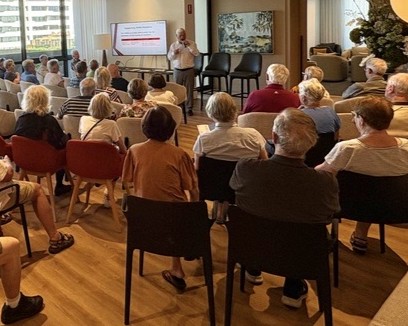
There’s a first for everything!
I was elected to the board of the RVRA last September and was given my first presentation to deliver on Wednesday the 11 March at Levande’s new retirement village The Cambridge, at Epping. This is a very new village, strategically located adjacent to the new metro rail service in downtown Epping. Around 140 residents have moved in with further occupation ongoing, supported with open days and media advertising.
Being a brand-new facility the residents were interested in understanding the role of the RVRA and forming a residents committee. Indeed, the presentation subject requested by Levande to be covered on the day was a question-and-answer session on setting up a Residents Committee.
I was elected to the board of the RVRA last September and was given my first presentation to deliver on Wednesday 11 March at Levande’s new retirement village - The Cambridge, at Epping. This is a very new village, strategically located adjacent to the new metro rail service in downtown Epping. Around 140 residents have moved in with further occupation ongoing, supported with open days and media advertising.
Being a brand-new facility the residents were interested in understanding the role of the RVRA and forming a residents committee. Indeed, the presentation subject requested by Levande to be covered on the day was a question-and-answer session on setting up a Residents Committee.
As part of an RVRA team including Diane Hart (Chair of the Education Centre) and Treasurer John Rosewarne, we arrived at Epping on a warm and humid day to meet a crowd of 60 or so residents and village staff.
I was allocated to talk about the role of the RVRA - who we are, what we do and some examples of what has been achieved in recent times. Diane spoke on the role of the Residents Committee and steps involved to form such a committee.
John spoke on the funding of the RVRA and membership.
During our presentations, attendees indicated to us a serious interest and desire to form a Residents Committee at The Cambridge. The interaction we had with residents both during and after the meeting was very positive and enthusiastic.
The outcome of our meeting was the group will work towards forming a Resident Committee, and a resident meeting to commence the process will be called as soon as possible. The other topic of interest discussed was that of liquor laws and logistics of running a bar. A further outcome of the afternoon saw 15 residents join the RVRA on the spot.
The RVRA provides comprehensive, printable resource sheets for NSW retirement village residents. These documents cover critical topics like resident committee roles, budget processes, information kits and residents’ rights aimed at supporting independent living and navigating the Retirement Villages Act and Regulation.
Looking specifically at Residents Committees, we provide information to RVRA members on the benefits of having a committee, establishing one, roles and responsibilities, and practical advice on conducting meetings, the budgetary process, as well as detailed guides.
For more information resources see
Village visits, such as the one conducted at The Cambridge or by Zoom if preferred, attract a small donation and can be arranged by calling 1300 787 213. Where there is a Residents Committee already established, training workshops are also on offer via the above number, both in person or by Zoom, at nominal cost.
We will be following up progress at The Cambridge in a month, as a workshop may be helpful once their new committee is up and running.
I look forward, as part of the RVRA, to visiting your village in the future as opportunities arise and where we can be of assistance and service to our members and village residents.
Colin Long
Board Member RVRA
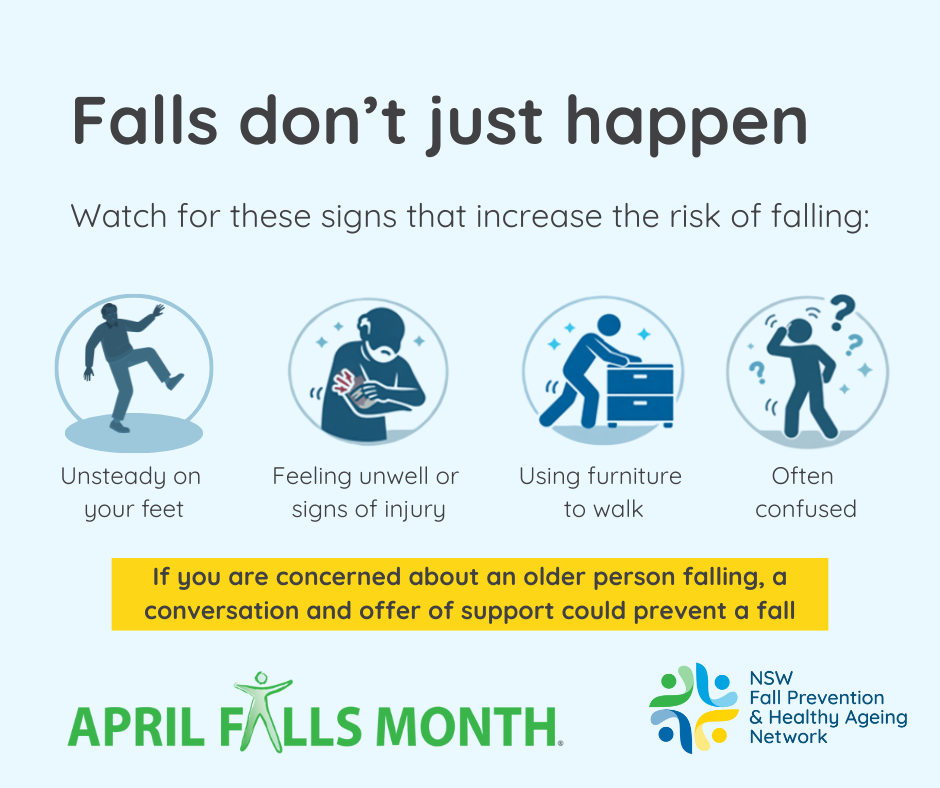
Take action to reduce your fall risk. Useful Links...
- Active and Healthy – find a local exercise program and resources to learn about healthy eating, getting active and falls prevention
- The Safe Exercise at Home website has been developed by physiotherapists for older people and people with mobility limitations.

Scam alert: Romance scams
6 Mar 2026 - National Anti-Scam Centre taskforce report highlights value of joint effort to tackle romance scams
How to spot a romance scam
Romance scammers often follow a similar pattern:
- Creating a fast emotional bond
- Moving conversations off platforms
- Avoiding in-person contact
- Introducing a financial request
- Applying pressure or secrecy

Need information or advice on elder abuse now?
CALL 1800 ELDERHelp ( 1800353 374 )
In an emergency call 000
This free number will redirect you to an existing phone service near you. This is not a 24-hour line. Call operating times will vary. A collaboration between the Australian, state and territory governments.

Free online presentations - April Topics
- April 16 - Understanding data and public Wi-Fi
- April 28 - How to use government websites
- April 30 - Helpful apps for your smart device

Help Us Keep Advocating for Fairness in Retirement Villages
Thank you for being a valued member of the Retirement Village Residents Association (RVRA) - or for considering membership. Our members' support has helped us continue advocating for fair treatment, stronger protections, and better representation for residents across New South Wales.
As you know, while most retirement village operators do the right thing, there are still many cases where residents are left vulnerable—facing unfair fees, poor communication, or inadequate dispute resolution.
With limited government resources and many competing priorities, retirement village concerns are often pushed to the side.
That’s why we are requesting your help.
A donation to the RVRA will directly support our work, including:
- Advocating for legislative reform
- Providing information and advice to residents
- Engaging with government and village operators
- Giving residents a stronger collective voice
You can donate online (either direct through our website or using GiveNow) at:
👉 https://www.rvra.org.au/donate
Every donation—no matter the size—helps us remain independent, effective, and committed to protecting the rights of all residents.
Thank you again for being part of this important association. Together, we can ensure retirement villages remain places of safety, fairness, and respect.
On behalf of the RVRA Board - thank you for your support.
Kind regards
Roger Pallant
RVRA President

The RVRA appreciates the support of the following professional services organisations.
To become a Supporter of the RVRA, contact us.